In the first half of 2026, the global electronics manufacturing industry is undergoing a profound supply chain restructuring. Frequent tariff policy adjustments have transformed "where to manufacture" from a cost optimization question into a risk management challenge. Industry reports indicate that an increasing number of OEMs now treat manufacturing geography as a strategic variable rather than a fixed decision, with single-country production concentration widely recognized as a supply chain vulnerability.
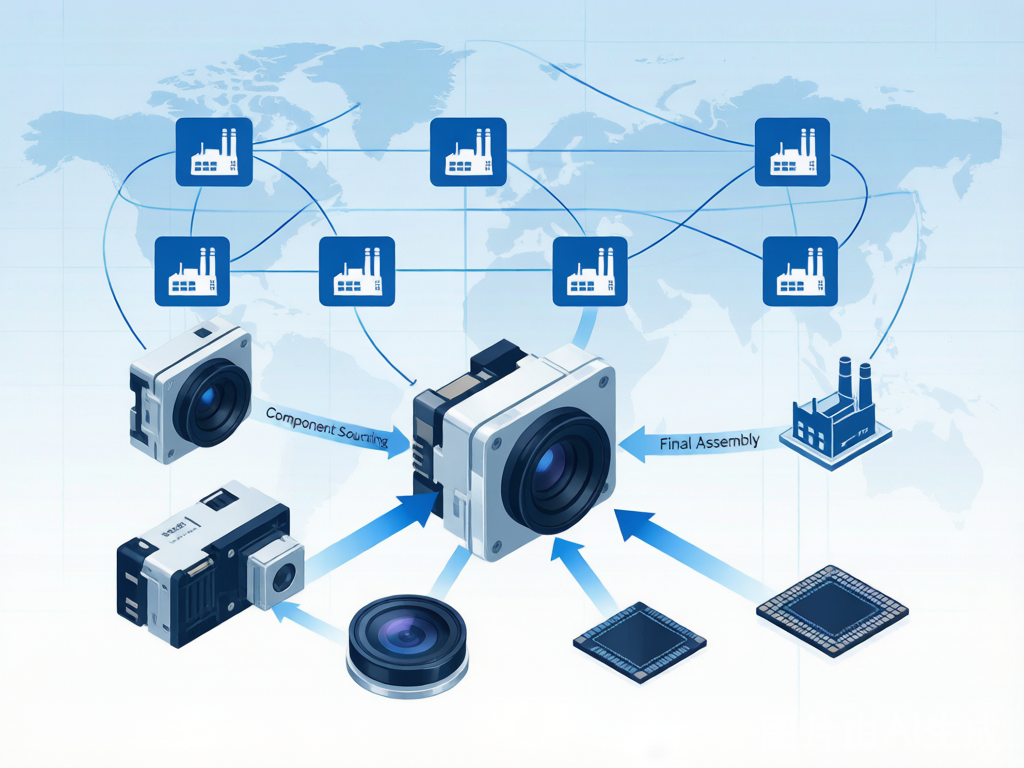
For overseas OEM/ODM customers sourcing camera modules, the direct impact is clear: can your module supplier maintain stable delivery amid shifting tariff landscapes? This article breaks down five critical supply chain risk points in camera module procurement and provides actionable solutions.
Why it's a trap: Many procurement teams choose a single module supplier for deep integration during the early project phase. In stable supply chain periods, this approach offers low communication costs and fast response. However, the 2026 tariff environment means any supply path can suddenly become economically unviable or infeasible due to policy changes.
Where the pit lies: When tariff changes cause cost spikes along a supply path, buyers without backup plans face two terrible options: absorb the cost increase and erode margins, or urgently find alternative suppliers—typically requiring months of re-qualification, with potential production line downtime during the transition.
How to break free: Establish a dual-source or multi-source procurement strategy. For highly customized components like camera modules, dual-sourcing doesn't mean two fully parallel production lines. Instead, ensure a pre-qualified backup supplier can absorb capacity within a short cycle when needed. The key is requiring standardized process documentation and test plans from suppliers during the product development phase, ensuring specifications aren't locked to a single factory's specific equipment.
Why it's a trap: Camera module design directly determines whether production can be successfully transferred between factories. Many buyers focus only on performance specs and pricing, overlooking how Design for Manufacturability (DFM) during the design phase profoundly impacts supply chain resilience.
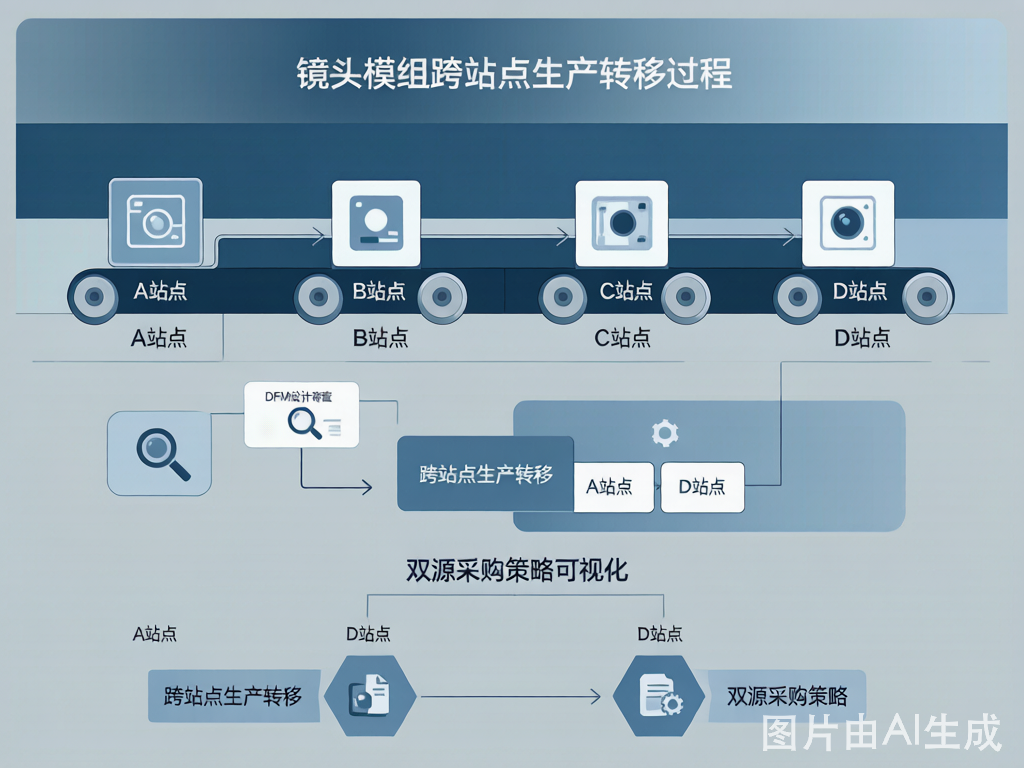
Where the pit lies: If a module solution has only been tuned on one factory's specific equipment, production transfer may require a full re-qualification cycle—including optical alignment, SMT parameter tuning, and reliability testing. In 2026's reality, when tariff pressure forces production relocation, products lacking a DFM foundation may take months to resume mass production at a new site, creating a delivery vacuum that can derail entire projects.
How to break free: Introduce DFM review at project kickoff. For camera modules specifically, focus on three points: First, ensure PCB panel designs are compatible with standard pick-and-place equipment, avoiding custom tooling dependencies. Second, verify that optical alignment uses industry-standard methods (such as Active Alignment) rather than a factory's proprietary process. Third, confirm that test plans are based on standardized image quality assessment procedures, making quality criteria reproducible across factories. Buyers should explicitly request DFM reports during supplier selection and list "cross-site manufacturability" as an acceptance criterion.
Why it's a trap: Some buyers believe that simply moving final camera module assembly to a third country will qualify for preferential tariff treatment. This assumption is increasingly untenable under 2026's heightened regulatory scrutiny.
Where the pit lies: Rules of Origin specify minimum local value-added thresholds. Under agreements like USMCA, qualifying for preferential tariffs requires meeting specific Regional Value Content (RVC) thresholds. The core components of camera modules—such as image sensor chips and optical lens assemblies—often originate from suppliers in specific countries. Merely changing the assembly location doesn't alter the product's substantial origin. More critically, regulatory authorities are increasingly scrutinizing "simple assembly" transfers, and those found engaging in transit trade without substantive value addition may face retroactive duties and penalties.
How to break free: Conduct a comprehensive origin compliance analysis before implementing any supply chain relocation strategy. For camera modules, address two levels: First, map the country of origin and value share of each BOM component to confirm whether local value addition at the target location meets preferential tariff thresholds. Second, maintain complete material traceability records and process value-add documentation for customs audit defense. If value addition is insufficient, consider introducing a higher proportion of local procurement or intermediate processing at the target location rather than simply relocating final assembly.
Why it's a trap: Camera modules are opto-mechatronic products where subtle manufacturing process variations affect imaging quality. When buyers need to transfer production between factories, the biggest challenge is often not equipment but process standard alignment.
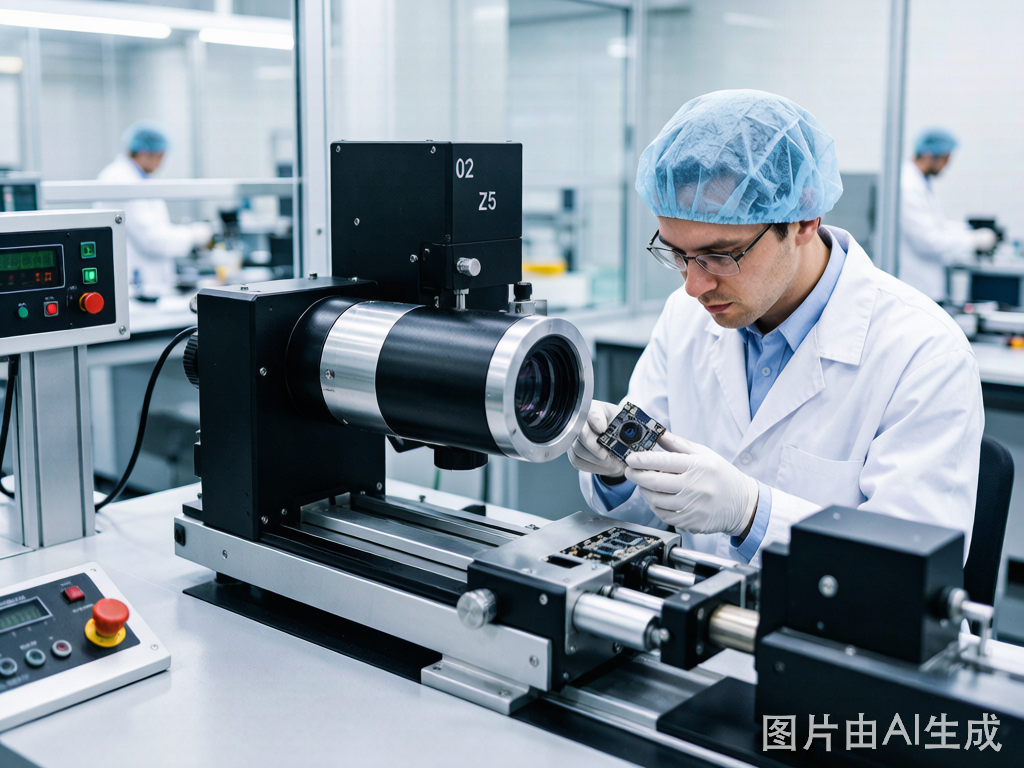
Where the pit lies: Different factories may have variations in alignment precision, soldering temperature profiles, and cleanliness control standards. Even with identical equipment models, operating parameters may differ between facilities. If these variations aren't systematically managed and standardized, cross-site production may experience batch-to-batch imaging consistency degradation and yield rate fluctuations, ultimately affecting end-product user experience.
How to break free: Require suppliers to establish and maintain a unified cross-site process standard documentation system, including: Standard Operating Procedures (SOPs), parameter control ranges for critical processes, quality inspection standards (AQL plans), and traceable SPC (Statistical Process Control) data. For camera modules, pay special attention to the standardization of the Active Alignment process—including focal length calibration range, optical axis deviation tolerances, and version management of auto-calibration algorithms. A competent supplier should be able to provide cross-site CPK (Process Capability Index) comparison data, demonstrating consistent quality output across different production locations.
Why it's a trap: In a volatile tariff environment, comparing only module unit prices no longer reflects true procurement costs. Many buyers are attracted by low prices but overlook hidden costs such as tariffs, logistics, qualification, and inventory, ending up with higher total expenditure.
Where the pit lies: A typical scenario: Supplier A's unit price is 5% lower, but its production location faces higher tariff rates; Supplier B's price is slightly higher, but its location enjoys preferential tariff treatment. Without Total Landed Cost analysis, buyers may incorrectly choose the apparently cheaper but actually more expensive option. Another common pitfall is underestimating supplier switching costs—re-sampling, pilot production, and quality confirmation typically account for 5%-10% of first-year procurement value.
How to break free: Build a total cost model incorporating: module unit price + tariff costs + international logistics + cross-site qualification costs + safety stock capital occupation + quality risk premium. For tariff costs, differentiate rates under various trade agreements and consider policy timeliness—today's preferences may disappear tomorrow. For safety stock, consider adding 2-4 weeks of buffer during periods of tariff policy uncertainty to absorb sudden supply chain adjustments. Additionally, negotiate flexible delivery terms (such as a combination of FOB and DDP) with suppliers, reaching prior agreements on tariff risk sharing.
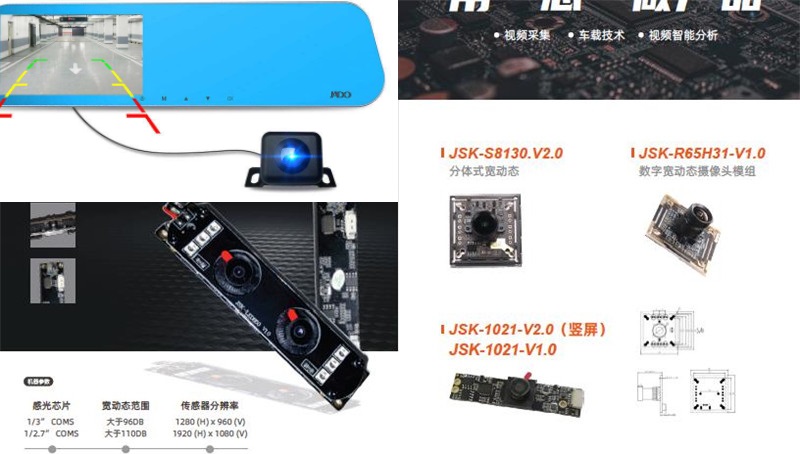
The tariff storm of 2026 won't subside quickly, and supply chain resilience will become a core competitive advantage in camera module procurement. Choosing a module manufacturer with standardized process systems, multi-site production capability, and comprehensive DFM support is key to navigating policy uncertainty. Jinshikang Technology specializes in camera module manufacturing, covering consumer electronics, automotive, security, and industrial inspection applications, providing standardized process workflows and full-cycle OEM/ODM services to help overseas customers maintain stable supply in turbulent times.


AR0230---1/2.7 HD 2M Wide Dynamic
Fatigue Monitoring Camera Module
Motion DV Camera-720P-120 Degree Wide Angle Camera Module
Night Vision Monitoring Camera Module
Monitoring - Doorbell - Law Enforcement Instrument Camera Module
Ten Thousand Trillion Industrial Camera Camera Module
 13423810014
 0755-29433686
 daming@cameras-module.com
 2/F, Building H, Zhiyihan Industrial Park, Yuanling Village, Shiyan Town, Baoan District, Shenzhen 518108



We use cookies to enhance your browsing experience. Continuing to browse indicates that you agree to our cookie policy.