The electronica China 2026 (Munich Shanghai Electronics Fair), held July 1–3 at the Shanghai New International Expo Centre, expanded to 120,000 square meters with 2,065 exhibitors — a 15% increase year-over-year. But beyond the numbers, the show delivered a clear signal: the semiconductor industry has completed a paradigm shift from "component competition" to "system competition," with AI redefining every chip category.
For camera module procurement, the most relevant change is this: ISPs (Image Signal Processors) are now fusing with vision AI capabilities, MCUs are integrating NPUs, and automotive SoCs are supporting Transformer architectures. The traditional approach of separately sourcing sensors, lenses, and ISP chips is being obsoleted. Camera module selection has officially entered the system-level era.
For overseas OEM/ODM procurement teams and hardware engineers, this is not a distant trend — it is happening on your BOM today. The following four points outline the key decisions for camera module selection in the age of AI-ISP convergence.
Why it's a trap: The traditional camera module selection logic is straightforward — pick a CIS sensor, match it with a mature ISP chip, add a lens and FPC, and procure each component independently. But at electronica China 2026, multiple chipmakers showcased next-generation ISPs that are no longer pure image processing pipelines — they are "vision SoCs" with embedded AI inference engines. These ISPs can perform scene recognition, intelligent HDR fusion, and adaptive noise reduction, and even output structured data directly.
Where the trap lies: Many procurement teams still select modules the old way — focusing on sensor resolution, lens FOV, and module dimensions, while ignoring whether the module is compatible with the target platform's AI-ISP architecture. The result: modules arrive, but the sensor's RAW data format doesn't match the AI-ISP's input preprocessing pipeline, or the sensor's HDR timing doesn't align with the ISP's AI fusion algorithm, causing final image quality to fall far below expectations.
How to break it: Incorporate AI-ISP platform specifications into the module requirements document from the outset. Specifically: (1) Define the target platform's ISP model and supported sensor interface protocols (MIPI CSI-2/CSI-3, DVP, etc.); (2) Confirm whether the ISP requires specific sensor initialization sequences or register configurations; (3) Request that the module supplier provide integration validation reports with the target ISP platform — not just the module's standalone test data. If you're unsure about the target platform's specifications, prioritize module solutions that have already completed integration validation with mainstream AI-ISP platforms.
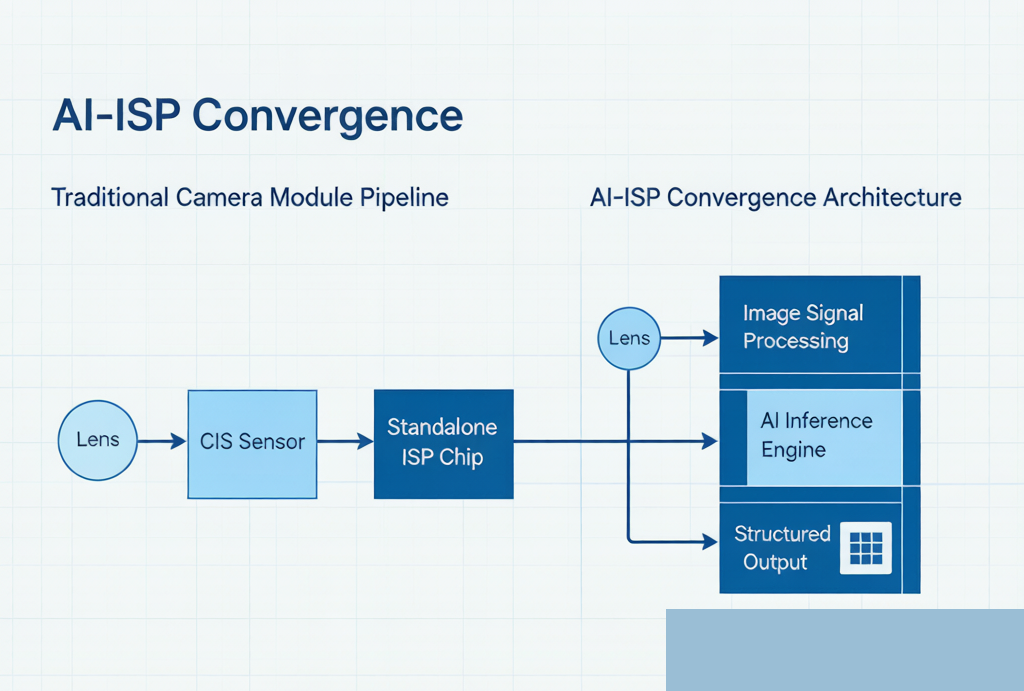
Why it's a trap: In the past, validating a camera module meant shooting a few test charts and checking resolution and color reproduction. But AI-ISP changes the image processing chain — the same sensor paired with different AI-ISPs can produce dramatically different imaging styles and quality. Traditional test methods cannot cover the variables introduced by AI-ISP.
Where the trap lies: During procurement acceptance, only module-level parameters (MTF, distortion, SNR) are checked. Once approved, modules are imported in bulk. After assembly on the production line and connection to the actual ISP platform, issues emerge: the AI noise reduction algorithm smears fine details in low light, or AI HDR fusion produces ghosting in high-speed motion scenes. By then, the module is already in mass production, and rework costs are enormous.
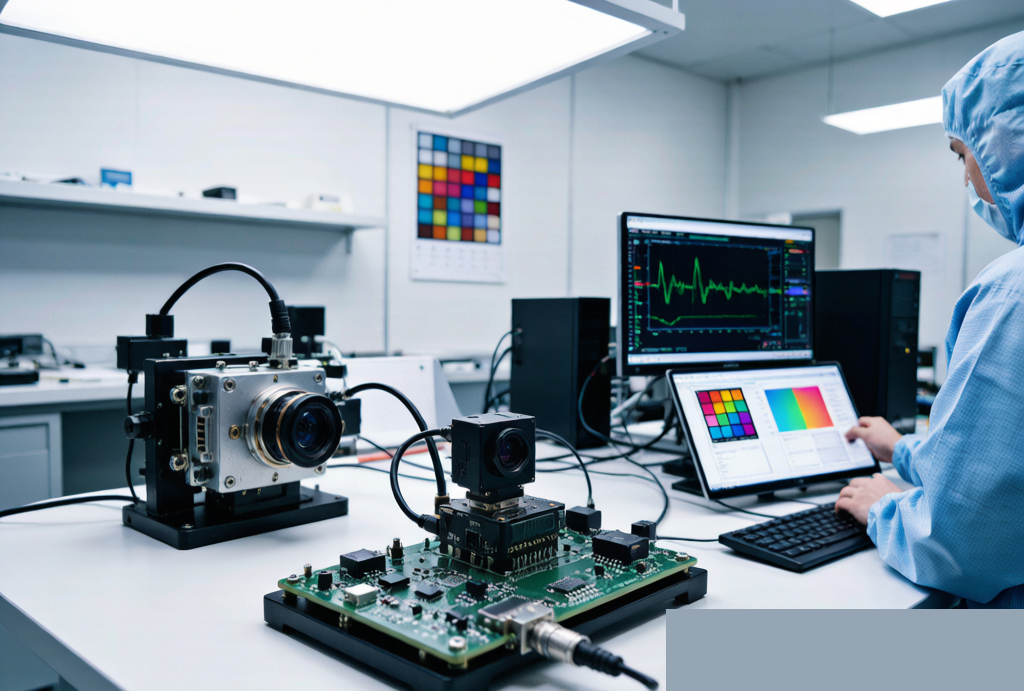
How to break it: Establish a "module + ISP platform" end-to-end validation process. We recommend three layers: (1) Module-level testing — confirm that optical and sensor baseline performance meets spec; (2) Platform integration testing — connect the module to the target AI-ISP development board, run the full ISP pipeline in a standard light box, and verify color consistency, dynamic range, and noise reduction; (3) Scenario-based testing — simulate real-world use cases (e.g., automotive night driving, industrial inspection of high-reflectance surfaces, wide-angle security surveillance) and evaluate AI-ISP imaging performance with real-scene data. Require suppliers to provide scenario-based test samples, not just factory test reports.
Why it's a trap: AI-ISP chips consume significantly more power than traditional ISPs when performing visual inference tasks. For space-constrained devices (smart glasses, miniature security cameras, industrial endoscopes), module thermal design and power budgets become extremely sensitive. At electronica China 2026, multiple vendors showcased ultra-low-power edge AI chips for wearables with power consumption down to milliwatts — but this requires the paired camera modules to equally support low-power characteristics.
Where the trap lies: During selection, only the module's static power consumption (standby current) is considered, ignoring the dynamic power draw of the sensor and interface chips when the AI-ISP runs at full speed. After the device operates for a while, the module area heats up, sensor thermal noise increases, and image quality degrades. In severe cases, the device triggers over-temperature protection, causing the camera to intermittently drop offline.
How to break it: (1) Require suppliers to provide power consumption curves across different operating modes (standby/preview/full-speed capture/AI inference linked), not just a single maximum value; (2) Specify the device's operating temperature range and require that module performance does not degrade within that range — for automotive and industrial scenarios, -40°C to 85°C is the baseline; (3) If the product has a compact form factor, prioritize module solutions that have undergone thermal simulation optimization, or request thermal test data from the supplier. For wearable devices, check whether the module supports dynamic frame rate adjustment, inter-row power gating, and other low-power modes.
Why it's a trap: Another signal from electronica China 2026: Chinese chipmakers are evolving from "budget alternatives" to system-level integrators, with domestic supply chain capabilities rapidly improving. For overseas procurement, this means more options — but also faster supplier technology iteration. Today's solution may face compatibility issues from ISP platform upgrades within six months.
Where the trap lies: A competitively priced but technologically slow-moving module supplier is selected. The initial product works fine, but when the product line needs to upgrade to the next-generation AI-ISP platform, the supplier cannot provide a compatible module solution in time, blocking product iteration.
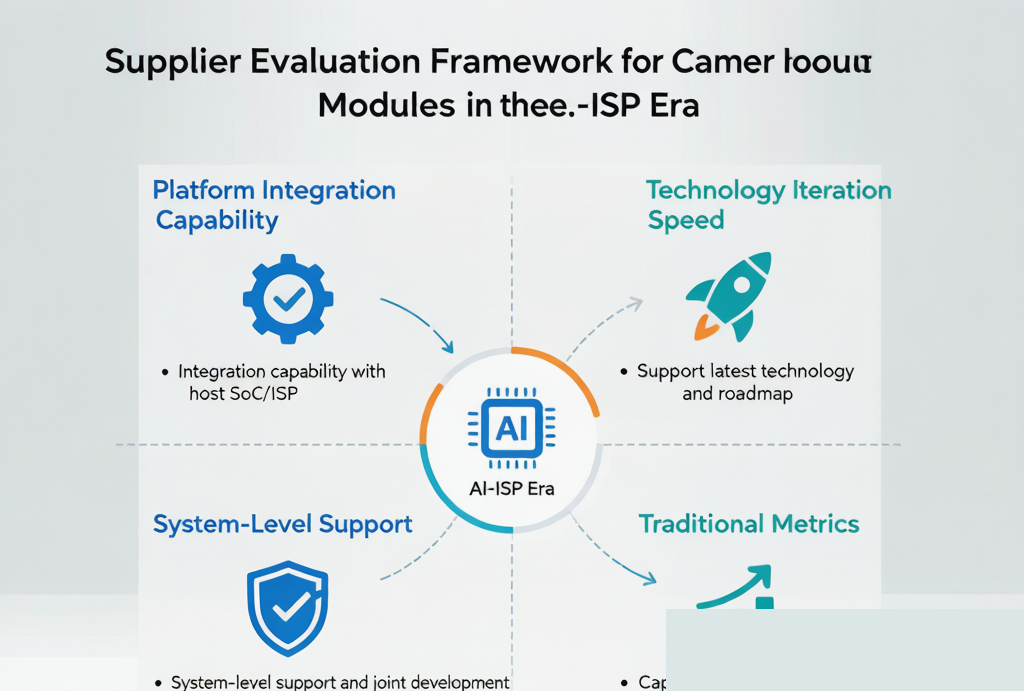
How to break it: When evaluating module suppliers, add three system-level dimensions to the standard capacity, yield, and lead-time metrics: (1) Platform integration capability — does the supplier have partnerships or integration experience with mainstream AI-ISP platform vendors; (2) Technology iteration speed — does the supplier's product roadmap update in sync with mainstream sensor and ISP platforms; (3) System-level support capability — can the supplier provide one-stop technical support from module selection to ISP tuning, rather than just delivering hardware. These three dimensions directly determine whether your product can maintain supply chain resilience amid rapid AI-ISP iteration.
The signal from electronica China 2026 is clear: camera modules are no longer isolated components — they are critical links in the AI vision system. Selection logic must upgrade from "component parameter comparison" to "system-level solution evaluation," focusing on AI-ISP compatibility, end-to-end imaging quality, power and thermal management, and the supplier's system integration capability.
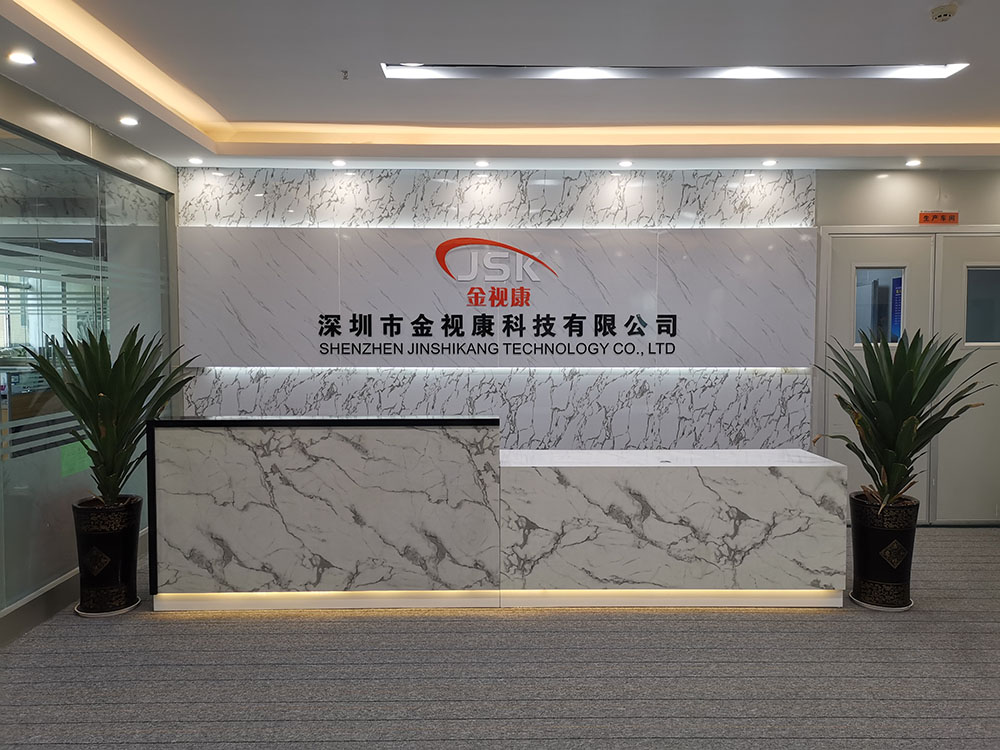
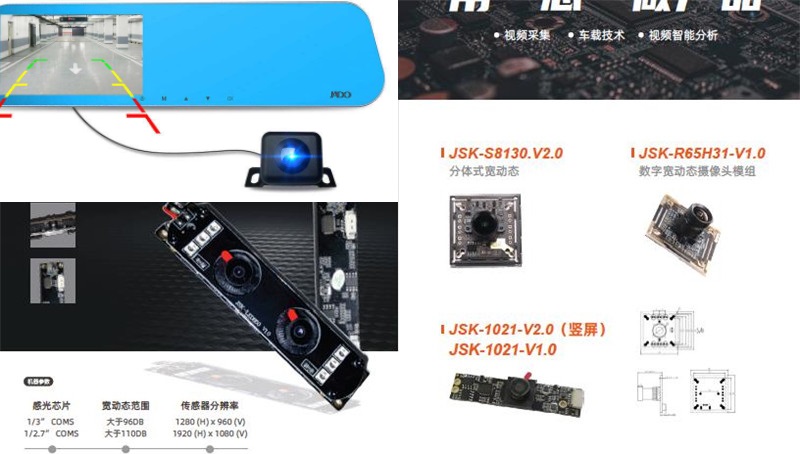
Jinshikang Technology specializes in camera module manufacturing, covering consumer electronics, automotive, security, and industrial inspection applications. With full-process technical support from module selection to platform integration, we help overseas OEM/ODM customers achieve rapid mass production in the AI-ISP era.


AR0230---1/2.7 HD 2M Wide Dynamic
Fatigue Monitoring Camera Module
Motion DV Camera-720P-120 Degree Wide Angle Camera Module
Night Vision Monitoring Camera Module
Monitoring - Doorbell - Law Enforcement Instrument Camera Module
Ten Thousand Trillion Industrial Camera Camera Module
 13423810014
 0755-29433686
 daming@cameras-module.com
 2/F, Building H, Zhiyihan Industrial Park, Yuanling Village, Shiyan Town, Baoan District, Shenzhen 518108



We use cookies to enhance your browsing experience. Continuing to browse indicates that you agree to our cookie policy.