On September 10, 2026, global automotive technology supplier Aptiv announced that its next-generation ADAS smart camera has entered mass production, featuring an 8MP camera, 120-degree field of view, a Chinese automotive-grade SoC, and StradVision perception algorithms, meeting Euro NCAP 2026 five-star safety rating requirements for a European-market vehicle program of a leading Chinese NEV manufacturer. The core signal of this news is not yet another 8MP front-view module reaching mass production, but rather: the automotive camera module is evolving from hardware delivery to compliant perception solution — single-SoC architecture integrating MCU reduces hardware size and power by 20% each, and perception algorithms are recalibrated for European road conditions. Overseas OEM/ODM buyers and engineers who still select modules with the old buy-bare-module-and-assemble-BOM mindset will hit pitfalls in the Euro NCAP 2026 compliance battle and the integration wave. This article breaks down five selection pitfalls and engineering breakthrough paths.
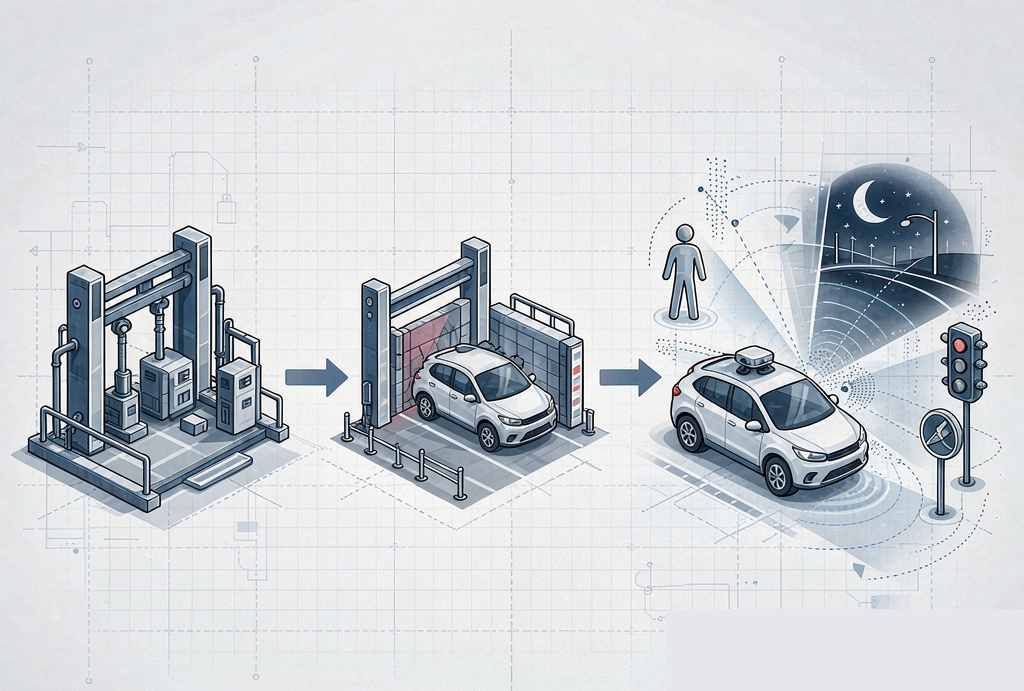
Euro NCAP 2026 five-star is a system-level safety rating, not a camera pixel metric. A common mistake among overseas buyers is treating 8MP front-view as a compliance pass, assuming that if the module reaches 8MP it will pass Euro NCAP. In reality, the Euro NCAP 2026 assessment covers automatic emergency braking (AEB), lane keeping assist (LKA), traffic sign recognition (TSR), pedestrian and vulnerable road user detection, and nighttime scenario testing — each dimension has independent thresholds for the camera dynamic range, low-light signal-to-noise ratio, HDR synthesis capability, and global-shutter motion-blur resistance. 8MP is merely a resolution baseline, not a sufficient condition for system compliance.
During selection, request a system-level metric matrix from the module supplier: beyond resolution and FOV, confirm the post-distortion-correction resolution at the 120-degree FOV edge, whether HDR dynamic range covers the strong backlit scenario at nighttime tunnel entrances, and whether the low-light SNR (below 5 lux) meets the AEB trigger threshold. Require the supplier to provide AEC-Q100 Grade 2 reliability reports and mass-production consistency CPK data, not lab sample photos. Under the Euro NCAP 2026 framework, the module must be jointly validated with perception algorithms — evaluating pixels alone is meaningless.

Aptiv smart camera adopts a single-SoC architecture that integrates the MCU inside the SoC, reducing hardware size and power consumption by 20% each. This represents an industry trend: the camera module is no longer an independent sensing hardware component, but a tightly coupled perception system of SoC plus module plus algorithm plus RTOS. Overseas OEM/ODM buyers who still plan with the separated purchase-bare-module-plus-select-own-SoC-plus-develop-own-algorithm architecture face three risks: first, the integration debugging cycle extends from weeks to months because the module ISP and SoC ISP may conflict; second, power and size cannot achieve the optimization level of integrated solutions; third, the know-how of algorithm-hardware co-tuning is scattered across different suppliers, leading to mutual finger-pointing when problems arise.
When evaluating module suppliers, prioritize those with integrated module-plus-SoC-adaptation-plus-algorithm-calibration delivery capability. Request reference designs showing the module MIPI CSI-2 interface docking validation report with mainstream automotive-grade SoCs. Define joint-debugging responsibility boundaries and SLA in the contract to avoid integration-stage responsibility vacuums. For vehicle programs with strict power and size requirements, purchase SoC-vendor-certified integrated module solutions directly, rather than self-assembling.
Aptiv smart camera is based on a Chinese automotive-grade SoC, entering a European-market mass-production program for a Chinese automaker. This shows that Chinese automotive chips are entering global Tier 1 standardized product stacks. However, overseas OEM/ODM buyers evaluating camera solutions with Chinese SoCs often overlook the completeness of the certification document chain: AEC-Q100 Grade certification only covers chip-level reliability; functional safety requires ISO 26262 ASIL level certificates; software process requires Automotive SPICE assessment; cybersecurity requires UN-R155 compliance. If the supplier only provides AEC-Q100 reports but lacks ISO 26262 ASIL declarations, the vehicle functional safety assessment (such as ASIL-B level front-view perception) cannot pass.
Build a certification document checklist during selection and verify each item: AEC-Q100 Grade 2 (or Grade 1 depending on mounting location), ISO 26262 ASIL level (front-view typically requires ASIL-B), Automotive SPICE Level 2 process assessment report, UN-R155 cybersecurity compliance declaration, PPAP production part approval documents. For European export projects, additionally confirm the SoC supplier Euro NCAP 2026 five-star compliance track record. Suppliers with missing certification documents should not enter the AVL approved vendor list for export projects, even if they have price advantages.

On this smart camera, Aptiv China and global engineering teams collaborated to recalibrate StradVision perception algorithms for European traffic conditions, road environments, and driving habits. This means: the same hardware plus algorithm combination that performs well on Chinese roads may fail Euro NCAP assessment when directly deployed in Europe. The pitfall is that overseas OEM/ODM buyers assume algorithms are universal and hardware in place is enough, overlooking the strong coupling between perception algorithms and regional road conditions. European roundabouts, narrow streets, bicycle mixed traffic, and rainy nighttime reflections differ vastly from China highway-priority wide-lane scenarios — algorithm calibration parameters require retraining and validation.
Request the module solution supplier to provide a regionalized algorithm calibration capability statement, confirming whether they have European real-road data collection datasets and calibration workflows. During evaluation, request simulation validation reports for Euro NCAP 2026-related test scenarios, not just Chinese road test videos. Reserve at least an 8-to-12-week European-standard recalibration window in project planning and include it in milestone plans. If the supplier can only deliver hardware modules without algorithm adaptation support, a separate algorithm supplier must be sought, increasing integration risk.
Automotive camera module export faces not just Euro NCAP but multiple regulatory standards. Front-view perception must simultaneously meet Euro NCAP 2026 five-star rating, UN-R159 rearview camera regulation, UN-R152 AEB regulation; if the vehicle is also produced in China, it must also satisfy GB 47955-2026 combined driving assist redundancy design mandatory national standard. The common pitfall for overseas OEM/ODM buyers is focusing only on Euro NCAP, overlooking the compounding effect of multi-standard parallel compliance timelines and testing costs. Different standards have overlapping but also divergent requirements for camera module metrics — a module solution optimized for a single standard may fail under another, causing rework.
Before selection, compile a regulatory standards matrix for target markets, cross-listing applicable standards by market (Europe, China, other) and function (front-view AEB, rearview, surround-view, DMS). Request the module supplier to provide a multi-standard compliance mapping table explaining how their solution covers metrics under Euro NCAP 2026, UN-R159, GB 47955, and other standards. Prioritize suppliers with existing multi-standard compliance cases to avoid the risk premium of first-time compliance projects. Plan testing and certification windows for each standard in parallel in the project timeline, rather than serially.
| Dimension | Check Item | Pass Criteria |
| System-Level Metrics | HDR dynamic range, low-light SNR, edge distortion | Euro NCAP 2026 scenario-level validation report |
| Integration Capability | Module plus SoC reference design | MIPI CSI-2 docking validation plus joint-debug SLA |
| Certification Documents | AEC-Q100, ISO 26262, ASPICE | Grade 2, ASIL-B, Level 2 complete reports |
| Algorithm Calibration | European road dataset plus recalibration process | 8-to-12-week Euro-standard window in milestones |
| Multi-Standard Compliance | Euro NCAP, UN-R159, GB 47955 | Multi-standard mapping table plus existing cases |
Euro NCAP 2026 five-star is a system-level safety rating covering AEB, LKA, TSR, pedestrian detection, and nighttime scenarios. For camera modules, 8MP and 120-degree FOV are baselines — the module must also meet HDR dynamic range for backlit scenes, low-light SNR for AEB triggers, global-shutter or high-frame-rate motion-blur resistance, and must be jointly validated with perception algorithms.
Single-SoC architecture integrates the MCU into the SoC, reducing hardware size and power consumption by approximately 20% each, lowering BOM costs, and simplifying module-SoC ISP conflict debugging. Buyers should prioritize suppliers with integrated module plus SoC plus algorithm delivery capability and request reference designs and joint-debug SLA.
AEC-Q100 Grade 2 (or Grade 1) chip-level reliability report, ISO 26262 ASIL-B functional safety certificate, Automotive SPICE Level 2 process assessment, UN-R155 cybersecurity compliance declaration, and PPAP production part approval documents are required. Front-view perception typically requires ASIL-B level.
European roundabouts, narrow streets, bicycle mixed traffic, and rainy nighttime reflections differ greatly from China highway-priority wide-lane scenarios. Perception algorithm calibration parameters require retraining and validation based on European real-road data. Project planning should reserve at least an 8-to-12-week European-standard recalibration window.
European market requires Euro NCAP 2026 five-star rating, UN-R159 rearview regulation, and UN-R152 AEB regulation; if also produced in China, GB 47955-2026 combined driving assist redundancy mandatory national standard applies. Selection should require suppliers to provide a multi-standard compliance mapping table.
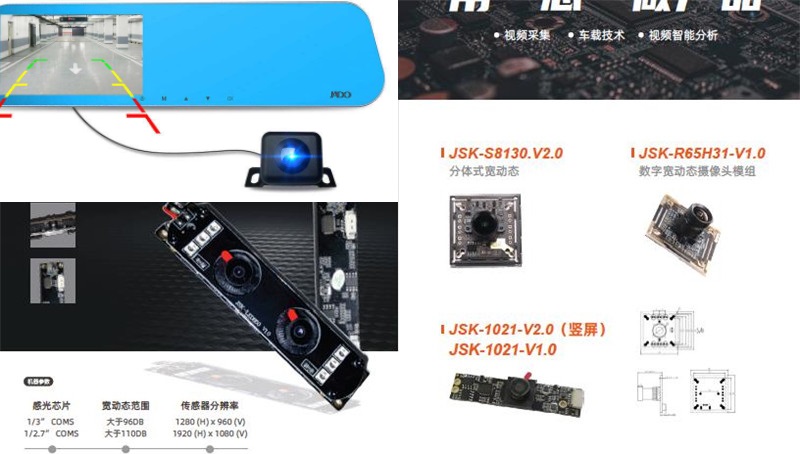
JSK Technology (JINSHIKANG TECHNOLOGY) specializes in camera modules covering consumer electronics, automotive, security, and industrial inspection applications, accepting OEM/ODM orders, and can assist overseas clients with automotive module system-level selection, SoC adaptation, and multi-standard compliance integration.


AR0230---1/2.7 HD 2M Wide Dynamic
Fatigue Monitoring Camera Module
Motion DV Camera-720P-120 Degree Wide Angle Camera Module
Night Vision Monitoring Camera Module
Monitoring - Doorbell - Law Enforcement Instrument Camera Module
Ten Thousand Trillion Industrial Camera Camera Module
 13423810014
 0755-29433686
 daming@cameras-module.com
 2/F, Building H, Zhiyihan Industrial Park, Yuanling Village, Shiyan Town, Baoan District, Shenzhen 518108



We use cookies to enhance your browsing experience. Continuing to browse indicates that you agree to our cookie policy.