In-cabin monitoring cameras are rapidly transitioning from a premium-vehicle option to a mass-market standard. Yole Group forecasts global annual shipments will exceed 70 million units by 2031. STMicroelectronics' VD56GA 1.1MP automotive CIS, released on October 5, 2026, is the latest confirmation of this trend—using a compact architecture, high near-infrared sensitivity, and embedded image processing to compress the BOM cost of an entire DMS/OMS module into the range mass-market vehicles can absorb. For overseas OEM/ODM procurement and hardware engineers, the key is not to blindly chase higher pixel counts, but to find the system-level optimum across five dimensions: resolution, NIR sensitivity, embedded processing, the automotive certification chain, and supply-chain resilience. This article breaks down the five most common pitfalls in selection, each structured as "why it's a trap → where the trap lies → how to break it."
Three concepts first. DMS (Driver Monitoring System) tracks the driver's eyelid closure, gaze direction, and head pose to detect fatigue and distraction; OMS (Occupant Monitoring System) focuses on rear-seat occupancy, child-left-behind, and seatbelt use. Together they form in-cabin monitoring.
Three regulatory forces are pushing it from option to standard: Euro NCAP's 2026 roadmap incorporates DMS into active-safety scoring; the EU's second General Safety Regulation (GSR2) mandates DMS on new passenger vehicles from 2026; China's GB 47955-2025, effective 2025, defines the functional requirements and test methods for distraction and fatigue detection. Together, these three standards mean vehicles without in-cabin monitoring will progressively lose five-star safety ratings in both Europe and China. This is the underlying logic behind the demand surge for mass-market automotive CIS like the VD56GA.
The VD56GA is a 1.1MP (approx. 1280x800) automotive CIS in a 3.7mm x 3.2mm CSP package, built on ST's new-generation DeepNIR backside-illuminated pixel architecture—delivering 35% higher modulation transfer function (MTF) sharpness and nearly 60% higher quantum efficiency (QE) in the 940nm near-infrared band versus the previous generation. It also integrates image-processing functions—mirror, crop, dark calibration, auto exposure—on-chip, supporting both RAW and YUV output. Front-end wafer fabrication is in Crolles, France; packaging in Asia, under ST's IDM (integrated device manufacturer) model. The design philosophy is clear: compact architecture + high IR sensitivity + integrated processing to help OEMs and Tier 1s drive down the cost of a complete DMS/OMS camera module and make in-cabin monitoring standard on mass-market vehicles. With this signal understood, the five pitfalls below are no longer isolated technical details—they are mandatory questions in system-level selection.
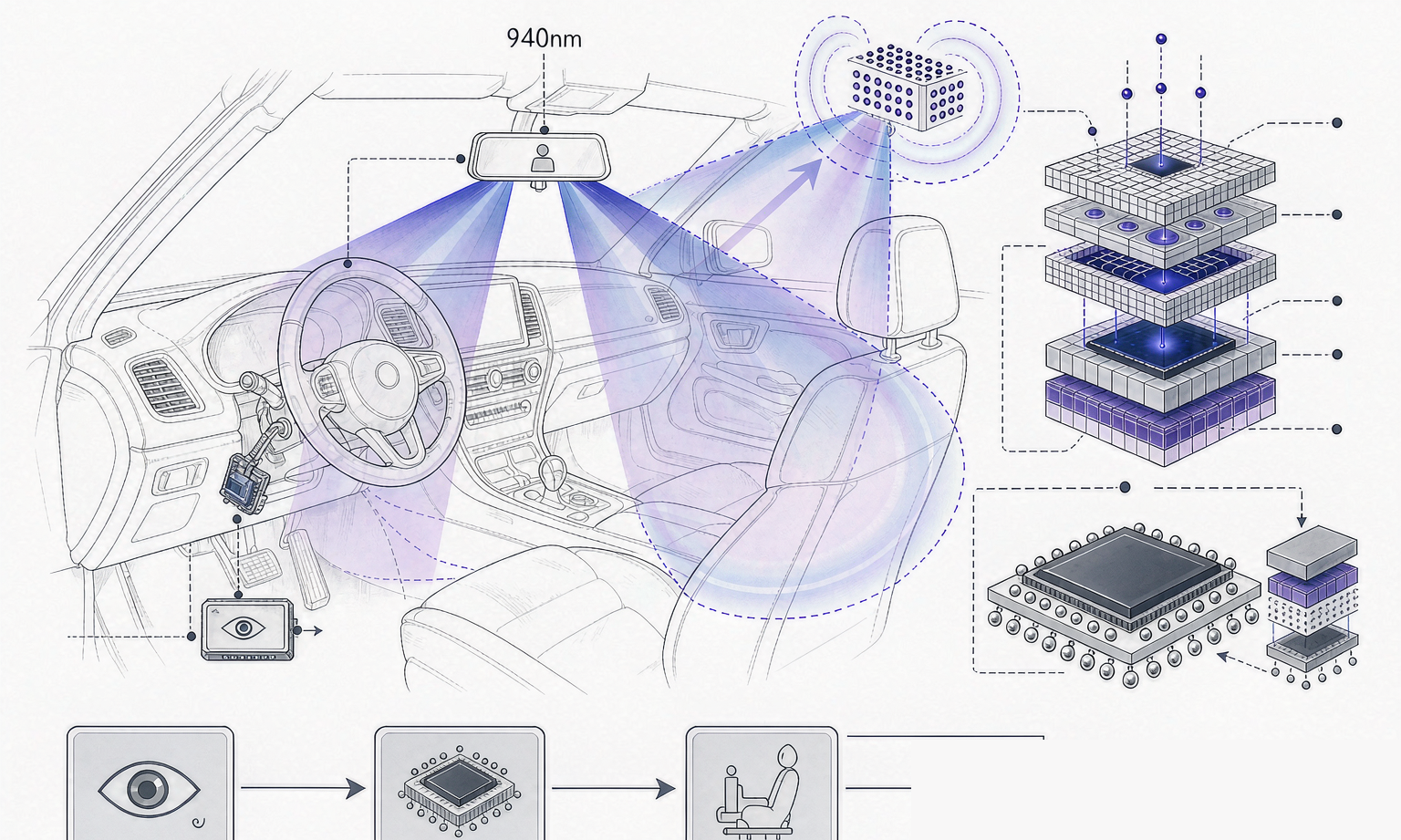
Why it's a trap: The consumer-electronics mindset defaults to "more pixels is better," and some suppliers' marketing pushes 2MP, 5MP, even 8MP solutions. But the core algorithms of in-cabin monitoring—eyelid-closure detection, gaze tracking, head-pose estimation—have bounded resolution needs; piling on pixels brings a chain of bandwidth, power, and compute burdens.
Where the trap lies: Mainstream DMS algorithms work reliably in the 0.3-1.3MP range; OMS rear-seat detection typically needs only 1-2MP. Higher pixel counts mean rising MIPI CSI-2 bandwidth pressure, higher SoC interface cost, and—critically—lower frame rates (high pixel counts with low frame rates hurt the temporal precision needed for eyelid-closure detection, which requires 30fps or above). Overall power and heat also climb.
How to break it: Derive resolution from algorithm needs, not from the supplier's top SKU. First, confirm whether the target algorithm is scalar-feature-based (fatigue/distraction decision) or deep-learning-based (behavior recognition); the former runs fine on 1MP-class YUV output, the latter may need 1-2MP RAW. Second, focus on "effective pixel utilization"—the share of pixels actually consumed by the algorithm—rather than raw total pixel count. ST's choice of 1.1MP rather than a higher count is itself a considered balance of real DMS needs and system cost, and is worth referencing.
Why it's a trap: DMS must work at night with no visible-light interference (the driver must not be dazzled by a red glow), so active near-infrared illumination is mandatory. But 940nm is nearly invisible to the human eye while traditional CIS QE there is low; 850nm produces a visible red dot but CIS QE is much higher. Choosing the wrong wavelength directly causes false negatives or false positives at night.
Where the trap lies: Picking 850nm seems attractive—bright and cheap—but the driver sees a red dot above the dashboard at night, hurting experience and inviting complaints. Picking 940nm is better for comfort, but if CIS QE is insufficient, you must either increase IR LED count and power (raising BOM and thermal cost) or sacrifice nighttime recognition rate. Many procurement teams read only the "NIR sensitivity" line on the datasheet without distinguishing whether the figure is for 850nm or 940nm.
How to break it: Prioritize high-QE 940nm solutions like the DeepNIR class. The VD56GA's nearly 60% QE improvement at 940nm versus the previous generation means fewer, lower-power IR LEDs can achieve the same illumination—lowering BOM and improving thermal performance. Second, the LED emission angle must match the lens FOV—narrow LEDs with wide lenses cause edge vignetting; wide LEDs with narrow lenses waste luminous flux. Third, require the supplier to provide a measured QE curve at 940nm, not a generic "high NIR sensitivity" description.
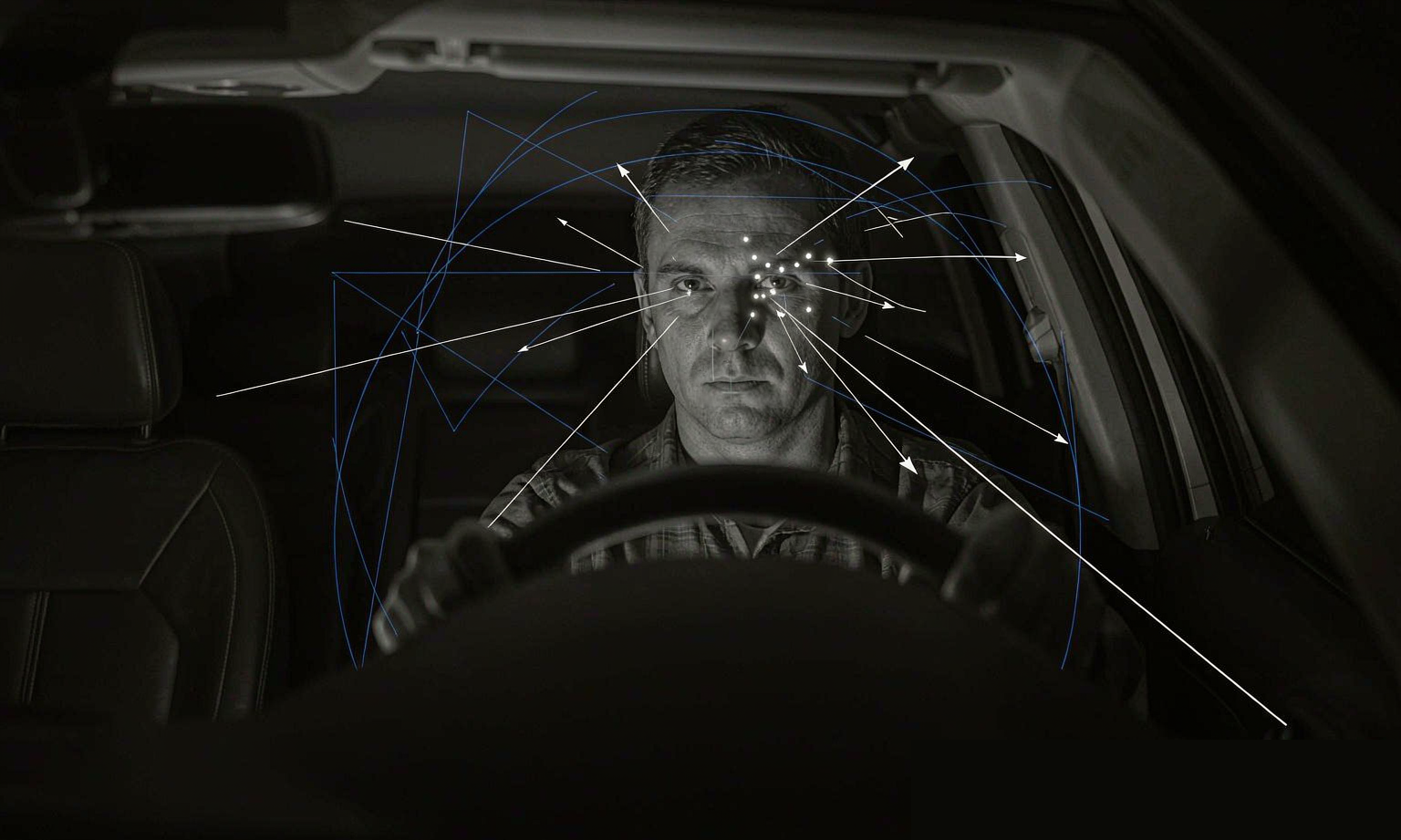
Why it's a trap: The VD56GA integrates mirror, crop, dark calibration, and auto exposure on-chip, and removing the external ISP lowers BOM. But integrated processing means constrained customization—if the algorithm needs RAW data for deep-learning inference, the on-chip ISP may actually become an obstacle.
Where the trap lies: The first trap is "saving the ISP but locking the algorithm"—some integrated ISPs output only YUV, with the RAW channel cut off, so later algorithm upgrades cannot reach the raw data. The second is "saving the ISP but adding a SoC"—you appear to remove one ISP chip, but because the output format is mismatched, the downstream SoC still has to do format conversion, effectively moving cost elsewhere.
How to break it: Separate requirements into two classes. Scalar algorithms (fatigue/distraction decision, eyelid-closure counting) use the integrated ISP's YUV output—optimal BOM. Deep-learning algorithms (behavior recognition, emotion estimation) need RAW data; pick a part with a full RAW channel and let an external SoC or NPU handle the ISP. Before signing, confirm three things: (1) is RAW output available; (2) can the on-chip processing chain be bypassed; (3) who owns the algorithm pipeline—the module vendor or the OEM's self-developed SoC. The VD56GA supports both RAW and YUV precisely to address both classes.
Why it's a trap: DMS involves functional safety—a distraction alert may trigger braking or steering intervention, so false positives or negatives have serious consequences. AEC-Q100 component-level certification alone does not cover system-level safety, yet many RFQs list only "AEC-Q100" as a single line, and the certification chain is found broken only at delivery.
Where the trap lies: A complete in-cabin monitoring certification chain has at least four layers—AEC-Q100 Grade 2/3 component-level (temperature grade), ISO 26262 ASIL-B system-level (functional safety), ASPICE Level 2 software process (code traceability), and—for under-display (behind-the-screen) installations—additional measured optical-attenuation data. The fourth is especially easy to miss: as DMS increasingly moves under-display, the OLED emissive layer attenuates the 940nm IR signal, and both MTF and QE drop; without under-display measured data, recognition rates inexplicably collapse in mass production.
How to break it: Require the supplier to provide the full certification chain at RFQ stage, not just check "AEC-Q100." The checklist should include: (1) AEC-Q100 certificate and Grade; (2) ISO 26262 ASIL-B system-level Safety Case; (3) ASPICE Level 2 assessment report; (4) for under-display mounting, measured 940nm MTF and QE attenuation curves through the OLED panel; (5) the PPAP (Production Part Approval Process) document package. Missing any layer means production and recall risk.
Why it's a trap: VD56GA front-end wafers are fabricated in Crolles, France, with packaging in Asia, under ST's IDM model. This layout is an advantage when capacity is ample (quality and supply stability), but when geopolitics triggers export controls, ADAS high-megapixel CIS squeezes wafer capacity, or natural disasters hit any link, single-source structures halt the OEM's line.
Where the trap lies: First, geopolitical risk—advanced-node CIS is exposed to export controls, and a single European source is not necessarily stable. Second, capacity crowding-out—8MP ADAS front-view CIS and in-cabin monitoring CIS share 12-inch BSI lines; higher-margin front-view orders will crowd out in-cabin capacity. Third, packaging concentrated in Asia is equally fragile to regional energy or logistics disruptions.
How to break it: Evaluate dual-source feasibility. ST's IDM model can be the primary source (quality and long-term support guaranteed); the second source can be a Chinese CIS vendor (SmartSens, OmniVision, etc., already in volume production for mid-to-high-end CIS). The cost of dual-source switching is re-qualification (two AEC-Q100 packages plus two Safety Cases), so it must start early—lock in dual-source strategy 18-24 months before SOP (start of production), not after a supply disruption. Also require the primary supplier to provide an LTB (last time buy) commitment and a clear substitute-part-number path.
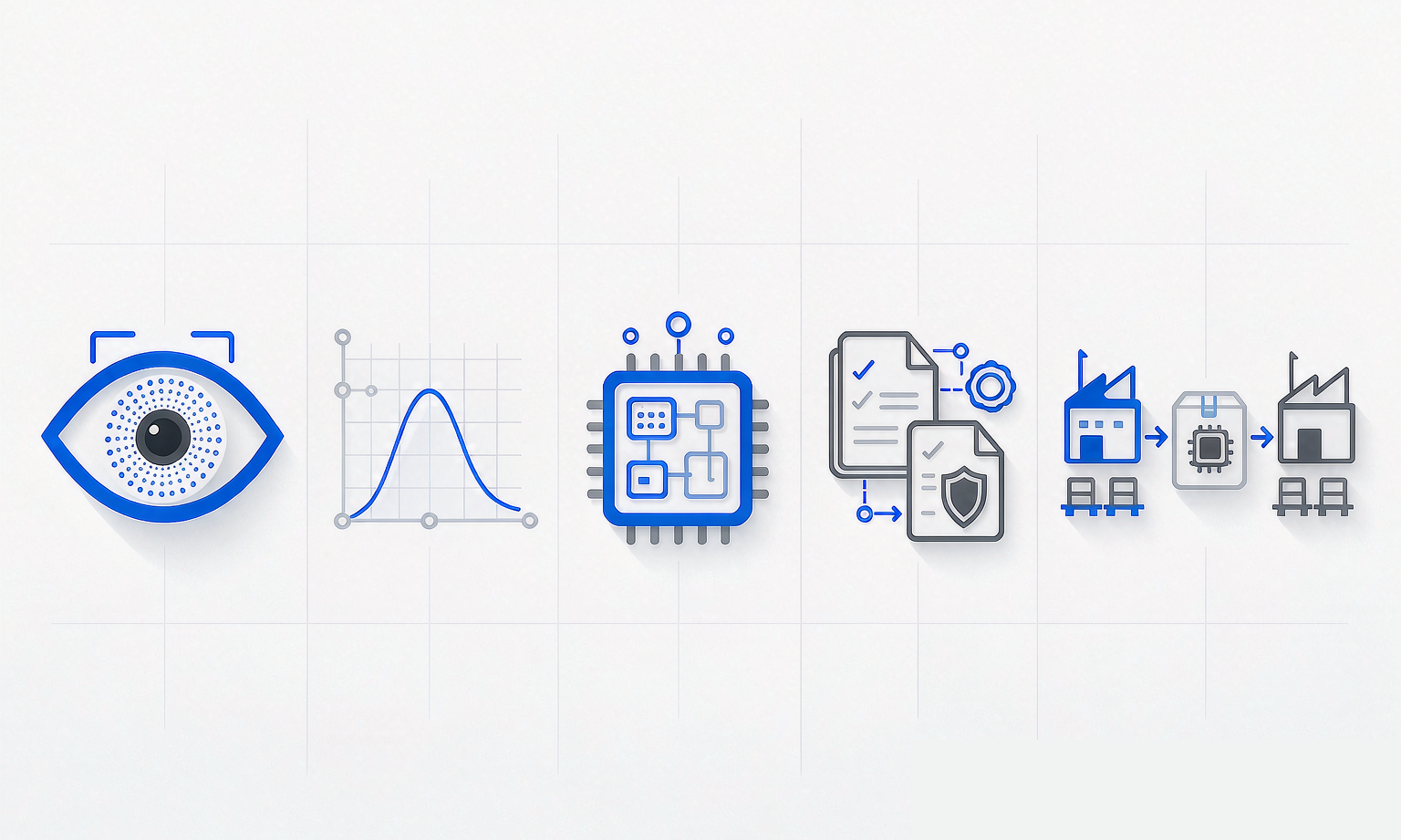
| Dimension | Check Item | Pass Criterion |
| Resolution | Derive from algorithm needs, not from supplier's top SKU | DMS 0.3-1.3MP / OMS 1-2MP; focus on effective pixel utilization |
| NIR sensitivity | Measured QE curve at 940nm, not generic "high NIR" | New-gen DeepNIR-class QE improvement vs prior gen >= 50% |
| Illumination match | IR LED emission angle matched to lens FOV | Edge vignetting <= 10%; LED power and thermal within limits |
| ISP architecture | RAW output available / on-chip ISP bypassable | Scalar algorithm uses YUV; deep learning uses RAW + external SoC |
| Certification chain | AEC-Q100 + ISO 26262 ASIL-B + ASPICE L2 | Under-display install requires extra MTF/QE attenuation data |
| Supply chain | Dual-source strategy and LTB commitment | Lock second source 18-24 months before SOP |
DMS (Driver Monitoring System) targets the driver, tracking eyelid closure, gaze direction, and head pose to detect fatigue and distraction; OMS (Occupant Monitoring System) targets all occupants, focusing on rear-seat occupancy, child-left-behind, and seatbelt use. Together they form in-cabin monitoring. DMS is typically mounted on the steering column or above the dashboard; OMS on the interior rearview mirror or headliner console, with different resolution and FOV requirements.
In-cabin monitoring must work at night with no visible-light interference and must not dazzle the driver with a red glow. 940nm near-infrared is nearly invisible to the human eye and is the standard DMS illumination wavelength; 850nm has higher CIS quantum efficiency but produces a visible red dot that hurts nighttime experience. Choosing a new-generation DeepNIR-class high-QE 940nm CIS balances experience and recognition rate.
Yes. Core DMS algorithms (eyelid-closure detection, gaze tracking, head-pose estimation) work reliably in the 0.3-1.3MP range. Piling on pixels increases MIPI bandwidth pressure, SoC cost, lowers frame rates, and raises power and heat. Derive resolution from algorithm needs and focus on effective pixel utilization rather than raw total pixel count.
A complete in-cabin monitoring certification chain includes AEC-Q100 component-level, ISO 26262 ASIL-B system-level, and ASPICE Level 2 software-process layers, plus the PPAP document package; the full cycle is typically 18-24 months. Under-display installations additionally require measured 940nm MTF and QE attenuation through the OLED panel. Therefore dual-source strategy must start 18-24 months before SOP.
In-cabin monitoring camera module unit prices vary substantially by resolution, NIR illumination scheme, and certification tier. Mass-market DMS standard solutions typically range from single-digit to low-teens USD; OMS, which needs a larger FOV and higher resolution to cover rear seats, is slightly higher. Adopting an integrated-ISP, high-QE 940nm CIS (such as a VD56GA-class solution) effectively compresses total BOM cost—this is the key technical lever enabling in-cabin monitoring to move from premium to mass-market vehicles.
In-cabin monitoring is repeating the trajectory ADAS front-view cameras traveled—"from premium option to mass-market standard"—only faster and under greater price pressure. The release of ST's 1.1MP VD56GA automotive CIS is, in essence, pressing four levers—resolution, NIR sensitivity, embedded processing, and supply-chain resilience—simultaneously toward the extreme of "designed for high-volume production." Jinshikang Technology specializes in automotive camera module OEM/ODM manufacturing, covering DMS/OMS in-cabin monitoring solutions. Overseas procurement and engineers are welcome to engage us on selection, certification, and mass production.
Jinshikang Technology Editorial Department | Published: 2026-10-07


AR0230---1/2.7 HD 2M Wide Dynamic
Fatigue Monitoring Camera Module
Motion DV Camera-720P-120 Degree Wide Angle Camera Module
Night Vision Monitoring Camera Module
Monitoring - Doorbell - Law Enforcement Instrument Camera Module
Ten Thousand Trillion Industrial Camera Camera Module
 13423810014
 0755-29433686
 daming@cameras-module.com
 2/F, Building H, Zhiyihan Industrial Park, Yuanling Village, Shiyan Town, Baoan District, Shenzhen 518108



We use cookies to enhance your browsing experience. Continuing to browse indicates that you agree to our cookie policy.