On October 13, 2026, Chinese CMOS image sensor maker SmartSens completed a CNY 3.2 billion (approx. USD 478 million) capital increase, explicitly targeting automotive electronics and AI vision expansion with focus on high-performance imaging, intelligent driving, and on-device AI computing. Around the same time, Tier 1 supplier Visteon published a report identifying a USD 650 million global addressable market for advanced camera and vision systems in off-highway vehicles (construction machinery, agricultural equipment, mining vehicles, marine vessels). Both signals point to the same conclusion: the next growth frontier for environmental perception cameras is not in passenger cars, but on job sites, farms, mines, and at sea. For OEM/ODM procurement and hardware engineers, this means camera module selection must shift from a "consumer-grade mindset" to a "harsh-condition mindset." The following five pitfalls are the most easily underestimated.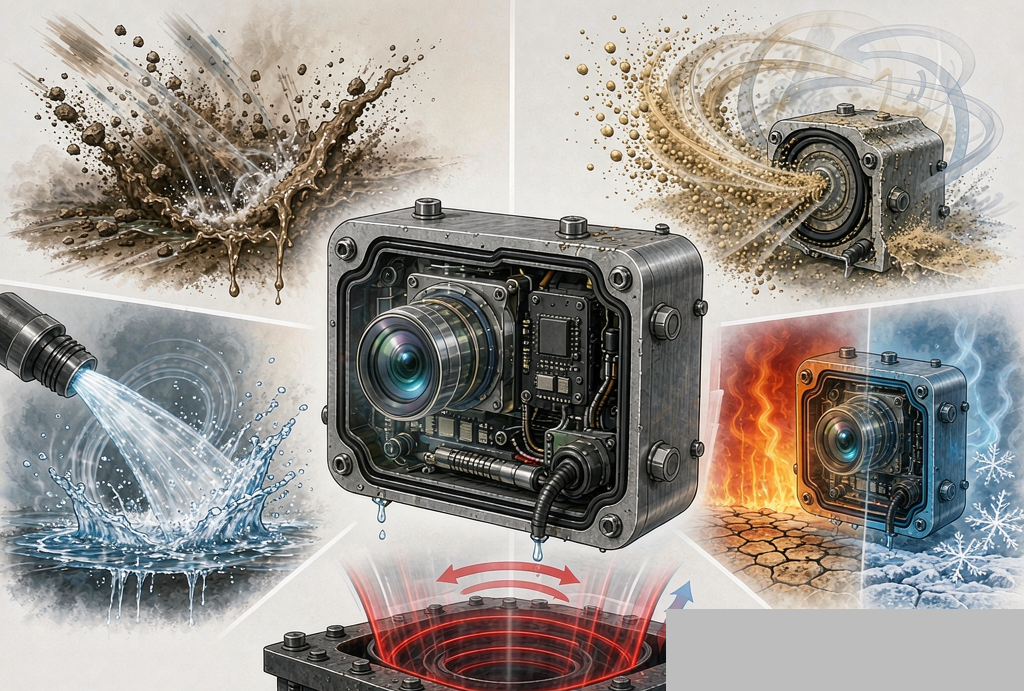
Why it is a trap: Many procurement teams conclude selection based solely on the IP68 rating in the datasheet, assuming "dust and waterproofing is maxed out." But IP ratings only describe static dust and water ingress protection, not temperature cycling, pressure washing, chemical corrosion, or vibration fatigue in composite conditions.
Where the pit lies: Construction machinery cameras face not laboratory water immersion but high-pressure water jet washing (car wash scenarios can reach 100+ bar), mud coverage that dries and shrinks to stress seals, and acid/alkaline cleaning agents corroding seal rings. The most typical failure mode: IP68 passes in the first 3 months, but after 6 months seal rings harden and crack, allowing moisture ingress that fogs lenses and corrodes sensors.
How to break free: During selection, look beyond IP ratings and require suppliers to provide three validations: First, high-pressure water jet impact test reports (recommend IPK9K standard, seal integrity at 80-100 bar). Second, seal durability testing after temperature cycling (100 cycles from -40 to +85 degrees Celsius, then retest waterproof rating). Third, chemical compatibility reports (seal ring compatibility with common site cleaning agents, hydraulic oils, and antifreeze). Also require module manufacturers to integrate pressure-equalizing vents (Gore-Tex or equivalent) during packaging design to balance internal/external pressure differentials and prevent seal failure during sudden temperature changes.
Why it is a trap: In off-highway scenarios, camera lenses are constantly exposed to mud, dust, and water contamination, making self-cleaning solutions a necessity. But the three mainstream approaches on the market each have specific application boundaries—selecting the wrong solution not only fails to clean but may also damage lens coatings.
Where the pit lies: The three approaches differ as follows: Ultrasonic self-cleaning uses high-frequency vibration to shake off particles, effective for dry dust but nearly useless for wet mud and oil; Mechanical wipers are simple and forceful, but moving parts have limited lifespan in vibration environments, and wiper blades wear lens surface coatings; Chemical coatings (hydrophobic/oleophobic) reduce adhesion, but UV exposure typically limits lifespan to under 6 months, degrading even faster in outdoor construction conditions. The most common mistake is using only a single approach that fails across different operating conditions.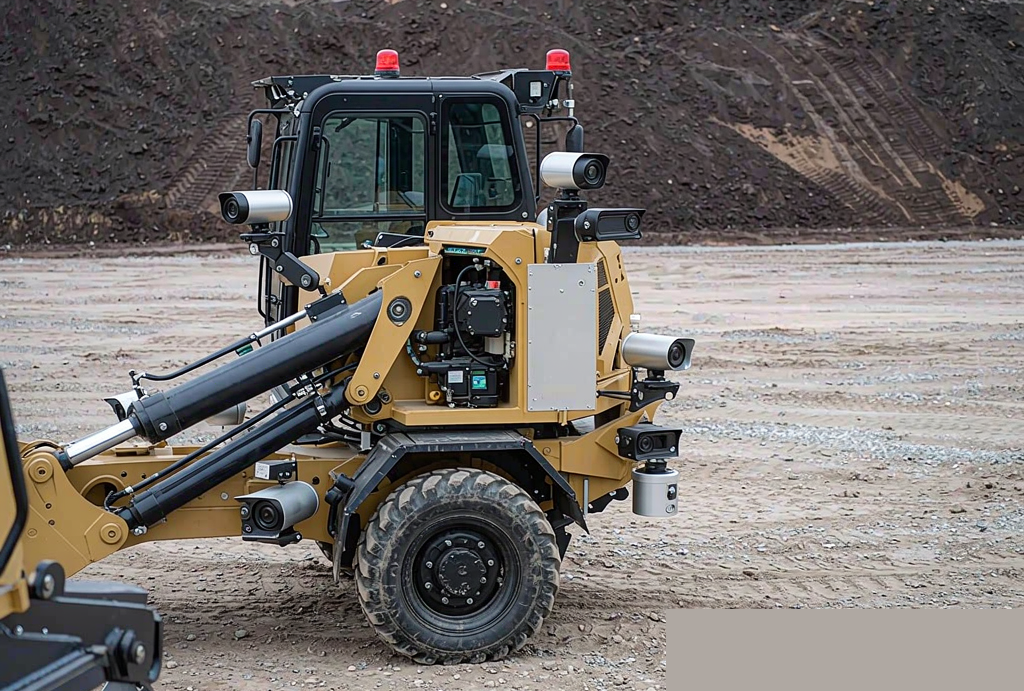
How to break free: Adopt a combined approach. Step one: determine the primary solution based on main operating conditions—dry, dusty environments use ultrasonic plus hydrophobic coating; mud and oil environments use miniature wipers plus coating to slow contamination. Step two: require module manufacturers to add replaceable protective lens covers (sapphire glass or hardened glass) on the outer lens layer, shifting cleaning solution wear from the lens itself to inexpensive, replaceable protective covers. Step three: introduce contamination detection at the system level—automatically determine lens contamination degree by analyzing contrast and sharpness distribution in camera output, triggering cleaning or alerts to prevent perception errors caused by dirty lens operation.
Why it is a trap: Manufacturer-specified HDR dynamic range (e.g., 96dB, 120dB) represents theoretical values under optimal laboratory conditions. In construction machinery scenarios, actual usable dynamic range is often only 60% to 70% of the specified value, directly causing overexposure in bright areas or complete darkness in shadow areas.
Where the pit lies: Failure scenarios are everywhere on job sites: excavators transitioning from shadow to direct sunlight experience exposure switching delays that cause target loss for several seconds; tunnel exit "white hole effect" makes obstacles ahead completely invisible; nighttime job site lights directly hitting the lens cause severe glare. These scenarios share common characteristics: dynamic range changes far exceed HDR mode inter-frame switching speed, and extreme contrast exists in local regions rather than the full frame. Single-frame HDR sensors (such as LOFIC architecture) perform better in these scenarios, but cost and power consumption are also higher.
How to break free: During selection, do not rely solely on specified dB values—require suppliers to provide three types of measured data: First, key scenario real-world sample images (backlit tunnel entry/exit, bright nighttime operations, shadow-to-sunlight transitions) rather than just laboratory dynamic range curves. Second, frame rate and latency data in HDR mode—if HDR mode frame rate drops below 15fps, moving objects will show smearing, unacceptable for safety perception scenarios. Third, clarify the HDR implementation method: multi-frame合成 (inter-frame motion artifact risk), single-frame multi-gain (elevated read noise), or LOFIC lateral overflow (hardware-level single-frame HDR, best effect but highest cost). For safety-critical scenarios, prioritize single-frame HDR solutions.
Why it is a trap: The operating temperature range in datasheets typically specifies -40 to +85 degrees Celsius or -30 to +70 degrees Celsius, but these are "steady-state temperature" metrics. Construction machinery actual conditions involve "temperature cycling"—daytime sun exposure reaching +70 degrees Celsius, nighttime drops to -20 degrees Celsius, repeated hundreds of times. Passing steady-state testing does not mean passing cycling tests.
Where the pit lies: Failures from temperature cycling occur not in the sensor itself but in the module-level interconnection weak points: VCM voice coil motor adhesive fails under thermal cycling causing focus drift; lens barrel material and lens holder thermal expansion coefficient mismatch causes optical center drift; AA (Active Alignment) adhesive layer develops microcracks after cycling causing concentricity changes; connector solder joints develop microcracks under thermal stress causing intermittent contact failures. More seriously, vibration compounds with temperature cycling: construction machinery vibration spectrum concentrates in the 20-200Hz range with accelerations up to 5-10gRMS, far exceeding consumer electronics' 1-2g test standards. Temperature plus vibration coupled failures often cannot be exposed in laboratory single-factor testing, only appearing after hundreds of hours of real-machine operation.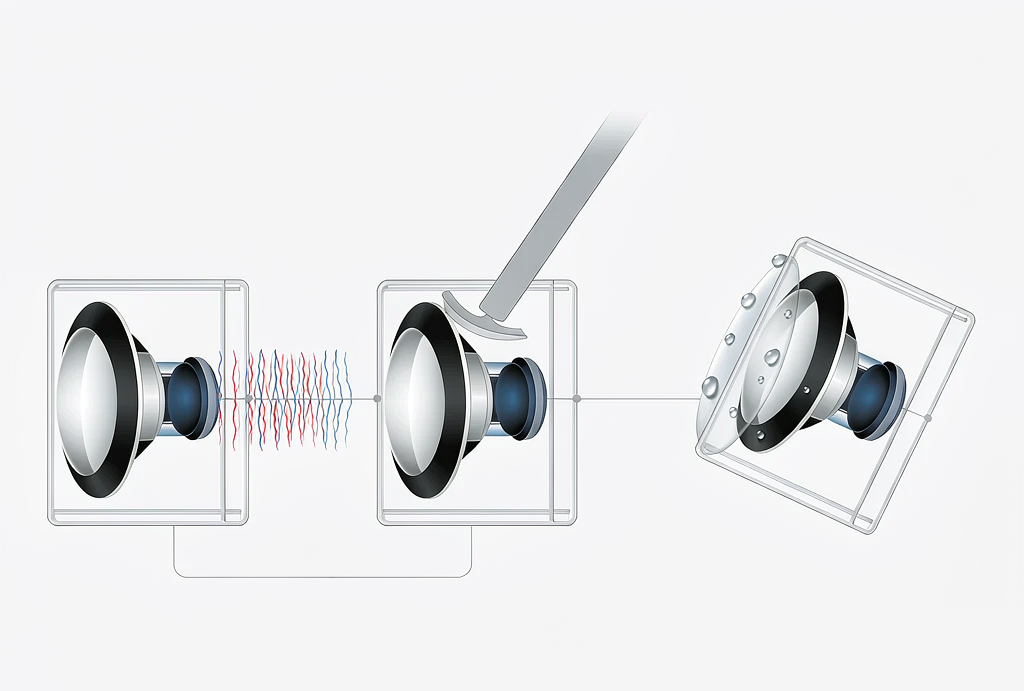
How to break free: Step one: require module manufacturers to provide temperature cycling plus vibration combined test reports (IEC 60068-2-14 temperature cycling combined with IEC 60068-2-64 random vibration), not single-factor tests. Step two: adopt thermal cycling-resistant processes during module design—use low-CTE epoxy for AA adhesive instead of UV adhesive; use same-type metal or matching-CTE materials for lens holder and barrel; select magnetic levitation or spring-type VCMs rather than adhesive-fixed types. Step three: require each shipment batch to include post-vibration optical performance retest data (MTF, distortion, focus drift) rather than testing only once before shipment.
Why it is a trap: Off-highway vehicles are rapidly adopting edge AI perception—surrounding object detection, pedestrian warning, remote control assistance. But many projects evaluate cameras and AI chips separately during selection, only discovering bandwidth and latency mismatches during integration, forcing resolution or frame rate reductions that significantly diminish perception capability.
Where the pit lies: Typical traps include: selecting a 4K HDR camera (approximately 12Gbps raw data rate) but the edge AI chip's MIPI CSI-2 input has only 4-lane (maximum approximately 8Gbps), forcing downgrade from 4K to 1080p or from HDR to SDR; camera outputs RAW format but AI chip can only process YUV, with intermediate conversion introducing latency and power consumption; multi-camera synchronization scenarios where inter-camera frame sync deviation causes fusion algorithm errors. The most hidden trap: some edge AI chips claim to support 4K input, but actually perform downsampling at the ISP backend, meaning the AI model processes resolution far below 4K, with perception accuracy silently compressed.
How to break free: Step one: jointly evaluate camera module and AI chip bandwidth contracts during early selection—confirm MIPI lane count, per-lane rate (D-PHY 2.5Gbps vs D-PHY 1.5Gbps), actual usable resolution and frame rate in HDR mode. Step two: confirm consistency between camera output format and AI chip input format, prioritizing AI chip solutions supporting direct RAW input to preserve maximum information. Step three: for multi-camera scenarios, require module manufacturers to provide hardware trigger sync capability rather than relying on software timestamp alignment. Step four: require AI chip suppliers to provide "actual processing resolution" rather than "supported input resolution" data to avoid the downsampling trap.
The core difference lies in operating condition severity and lifespan requirements. Passenger vehicle cameras operate in relatively controlled environments (vehicle body sealing, limited temperature fluctuation), while construction machinery cameras are exposed to composite conditions including mud, high-pressure washing, extreme temperature cycling, strong vibration, and chemical corrosion, with lifespan requirements typically 10-15 years far exceeding passenger vehicles' 8-10 years. Selection standards cannot directly apply automotive-grade AEC-Q100 alone; they must also include IEC 60068 environmental testing and real-world condition validation.
According to Visteon's 2026 report, the global addressable market for advanced camera and vision systems in off-highway vehicles is approximately USD 650 million, covering Europe (high-end applications with strong technology demand), North America (scale and increasing automation), China (high volume with cost pressure), Japan and South Korea (technology and automation), and India (growth potential with localization needs). Compared to the passenger vehicle ADAS market, off-highway scenarios have smaller per-project volumes but higher customization premiums and fewer competitors, suitable for module manufacturers with flexible manufacturing capabilities.
There is no single optimal solution—combine approaches based on main operating conditions. Dry, dusty environments use ultrasonic plus hydrophobic coating; mud and oil environments use miniature wipers plus replaceable protective covers; extreme environments combine all three. The key is adding contamination detection at the system level (automatically determined through image contrast and sharpness analysis) to prevent perception errors from dirty lens operation.
The key is jointly evaluating bandwidth contracts during early selection: confirm MIPI lane count and per-lane rate, actual usable resolution and frame rate in HDR mode, and consistency between output format and AI chip input format. Multi-camera scenarios require hardware-level frame synchronization. Also request "actual processing resolution" rather than "supported input resolution" data from AI chip suppliers to avoid the downsampling trap.
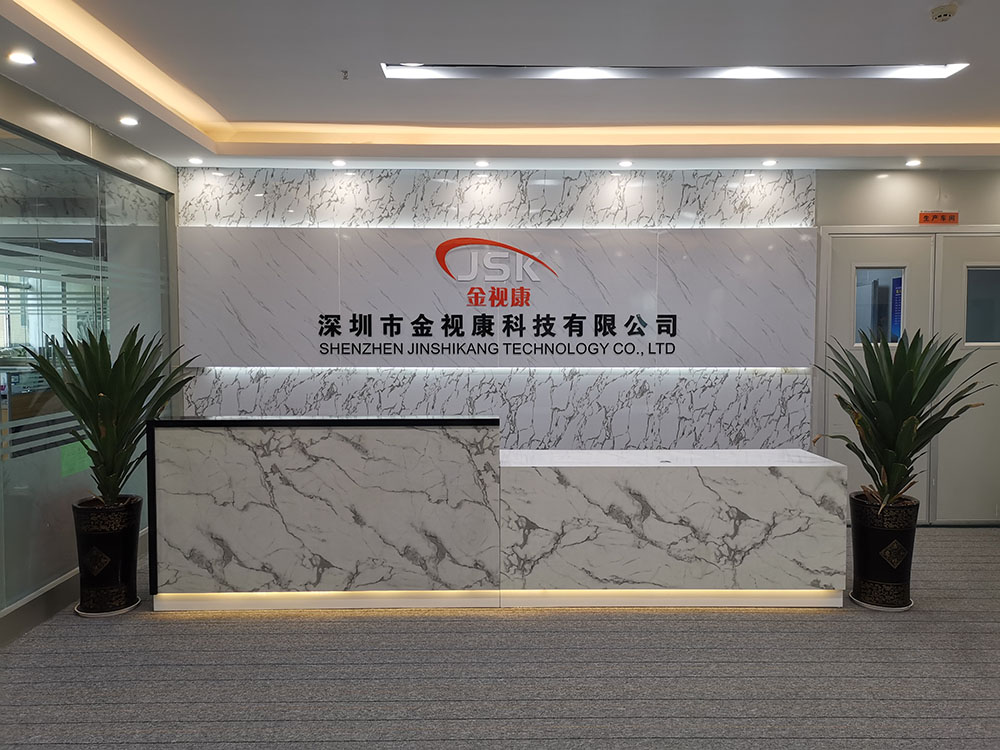
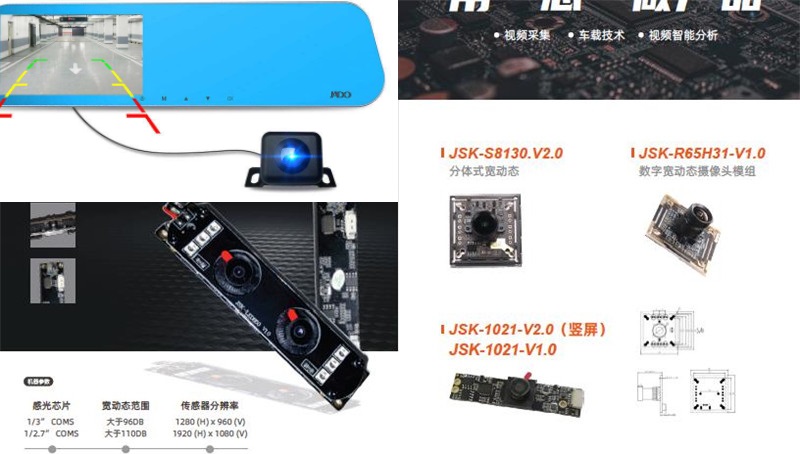
Jinshikang Technology specializes in camera module manufacturing, covering consumer electronics, automotive, security, and industrial inspection scenarios. With capabilities in harsh-condition module packaging, automotive-grade reliability testing, and customized optical solutions, we accept OEM/ODM orders for construction machinery, agriculture, marine, and other off-highway environmental perception applications, helping overseas customers achieve reliable deployment in the environmental perception market.


AR0230---1/2.7 HD 2M Wide Dynamic
Fatigue Monitoring Camera Module
Motion DV Camera-720P-120 Degree Wide Angle Camera Module
Night Vision Monitoring Camera Module
Monitoring - Doorbell - Law Enforcement Instrument Camera Module
Ten Thousand Trillion Industrial Camera Camera Module
 13423810014
 0755-29433686
 daming@cameras-module.com
 2/F, Building H, Zhiyihan Industrial Park, Yuanling Village, Shiyan Town, Baoan District, Shenzhen 518108



We use cookies to enhance your browsing experience. Continuing to browse indicates that you agree to our cookie policy.